- Glint Solar
- Nordson
- 3D Print Bureau
- 6K
- Agmatix
- Airwayz
- AKA Foods
- AM-Flow
- Appadda
- BMF
- Caracol
- Carbon
- CG Trader
- Conflux
- CyberOptics
- e-Xstream
- Flamerite
- GenCell
- GreenEye
- Impossible Objects
- Incus Media
- Ineco
- InkBit
- ITG
- JPB Systeme
- KeyProd
- Landa
- Leading Edge Only
- LEO Lane
- Lumet
- Nikon
- Magic Software
- MakerBot
- Marketiger
- Nano Dimension
- Nivalis
- Paragon Rapid Technologies
- PearlX
- Plant & Bean
- Redefine Meat
- Replique
- Ripples
- Sakuu Corporation
- Segen
- SolarEdge
- StoreDot
- Sunrock
- The Bespoke Group
- Trigo
- UltiMaker
- Xjet
The European Community of Alsace is equipping its headquarters, the Hôtel d’Alsace, in the heart of Strasbourg city centre, with a solar power plant to boost its energy self-sufficiency
- Installed on the roofs of the Hôtel d’Alsace, this new photovoltaic power plant marks a major milestone in the CeA’s long-term strategy for clean energy and cost control.
- The solar power plant achieves a self-consumption rate of 100%, covering just under 10% of the site’s energy needs, representing an annual saving of~ 24 000 € on its electricity bill in 2025.
- As with most sites already fitted with photovoltaic systems by the local authority, SolarEdge’s innovative solar technology with Power Optimizers was chosen to overcome the limitations of traditional string solar systems, with the aim of optimising yield and improving safety.
Strasbourg, France – 6th June 2026 – The European Community of Alsace (CeA) announces the commissioning of a self-consumption solar power plant on the roofs of the Hôtel d’Alsace, its headquarters located in the heart of Strasbourg. This new installation forms part of a long-standing strategy to promote the energy transition and control the operating costs of its property portfolio.
Against a backdrop of changes to the S21 regulations and high volatility in electricity prices, the CeA sought to secure its energy expenditure in the long term whilst strengthening its energy independence. To this end, the local authority chose to invest heavily in solar energy.Since 2021, it has installed solar panels at 50 sites (including 46 secondary schools), totaling 5.3 MWp and has already seen positive results in terms of solar self-consumption. Indeed, the equipped sites self-consume all or part of the photovoltaic output, and the surplus is used to supply other sites within the local authority, via a short circuit known as ‘heritage self-consumption’, which is currently being trialed with Energies Strasbourg.
Encouraged by these positive results, CeA councillors have decided to continue rolling out photovoltaic installations, and the fitting of at solar panels the Hôtel d’Alsace enables this commitment to be realised at one of the local authority’s main sites.
Estelle Le Roy, Head of the Renewable Energy Department at the CeA, emphasises: “The Hôtel d’Alsace is a public-access building of significant heritage value, which means there are high standards regarding electrical safety and risk management. It was essential to ensure the protection of both the occupants and the building itself. We have, in fact, adopted the same strategy in secondary schools developed at the outset of the photovoltaic scheme in collaboration with the fire and rescue services. This is why we chose to utilize the innovative technology of Power Optimizers. Installed beneath each pair of panels, these devices enhance safety by ensuring a very low residual voltage at the panel output in the event of a power cut. Furthermore, they allow us to monitor the performance of each panel, which helps us to optimise the operation of our power stations .”
A bespoke installation for a particularly complex project
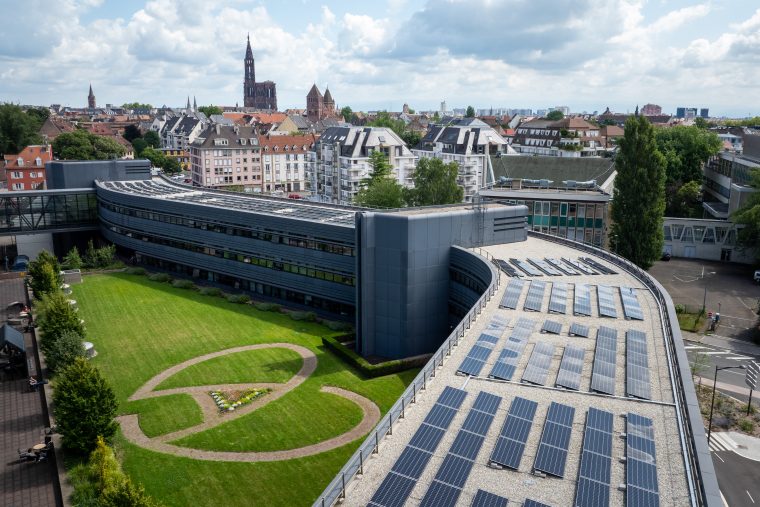
Located in the city centre and featuring unique architecture with a curved roof, the Hôtel d’Alsace presented a high level of complexity in harmoniously integrating a solar installation. expertise Technical and effective communication between the client, project manager, installer, Architectes des Bâtiments de France and technical supervisor enabled to the project’s feasibility be confirmed and the most suitable solution to be identified. The building’s heritage value required a genuine aesthetic approach in addition to the standard requirements location and applicable to all the local authority’s. photovoltaic projects
The curvature of the roof creates few areas shaded, but these are nevertheless taken into account to optimise production. Shading significantly reduces the efficiency of conventional solar systems. Indeed, with traditional string inverters, when a single panel is shaded and its performance is reduced, all the panels connected to the same string are limited to the performance of the weakest panel, leading to a significant drop in overall production.
This is why the European Community of Alsace has opted for SolarEdge’s innovative DC optimisation solution, which relies on the use of Power Optimizers installed beneath each pair of photovoltaic panels. This approach allows each pair of panels to be ‘individualized’, so that the performance of modules adequately exposed to the sun is not affected by those in the shade, thereby maximising energy production and ensuring the project’s economic viability.
Over the course of a year, the solar power plant covers just under 10% of the site’s total consumption, representing an annual saving of ~ €24,000 in 2025.
Maximum safety for an exceptional public access building
As a public access building (ERP), the structure is subject to particularly stringent safety requirements. In this regard, the solar system is equipped with SolarEdge’s SafeDC™ function, designed to automatically reduce the voltage of the photovoltaic array to 1 V (a voltage safe to touch) as the inverter or the grid is switched off. This feature is essential for ensuring the safety of occupants, maintenance operations and emergency response teams. This safety requirement is now further reinforced by the CNPP Certified accreditation obtained by SolarEdge for its electric arc detection solution for photovoltaic installations[1] : an accreditation recognised by the APSAD D20 standard for fire risk protection.
A flagship project that positions the CeA at the forefront of a sustainable energy transition serving the region
With this flagship project, the European Community of Alsace confirms its role as a key public driver in the regional energy transition, combining technological innovation, respect for heritage and sound public finance management.
Martin Wolf, co-founder and partner at Enerios Associés, explains: “This approach offered greater flexibility for the client and for us, the installer. Given the building’s complex multi-facade design, this installation, equipped with Power Optimizers, enabled a significant reduction in the volume of solar cabling compared to a traditional string-based installation. Clearly, this had an impact on the project budget. The SolarEdge solution we chose also enabled very rapid commissioning, thanks in particular to its ultra-simplified SetApp (configuration) application. It really is straight forward! Finally, thanks to the dedicated app, the highly precise monitoring that allows faults to be analysed in advance helps reduce operational costs for corrective maintenance. More specifically, monitoring at the module pair level saves us both time and money.”
[1] The certification covers SolarEdge three-phase commercial inverters and three-phase inverters with Synergy Technology (SE20k to SE120K), as well as the S Series commercial power optimizers (S1000, S1200 and S1400). Certificate No. 99.25.221.
Romain Rocamora, Head of Sales and Channel Manager at SolarEdge Technologies France, adds: “Projects such as the Hôtel d’Alsace demonstrate how advanced solar technologies can unlock the full potential of some of the most complex and sensitive buildings. By combining panel-level optimisation with enhanced safety features such as SafeDC™, we enable public bodies such as the European Community of Alsace to maximise their energy production, ensure the highest safety standards, simplify long-term operation and maintenance, and support local authorities in their transition towards greater energy independence.”
-
 omain Rocamora, Head of Sales and Channel Manager at SolarEdge Technologies France, adds: “Projects such as the Hôtel d’Alsace demonstrate how advanced solar technologies can unlock the full potential of some of the most complex and sensitive buildings. By combining panel-level optimisation with enhanced safety features such as SafeDC™, we enable public bodies such as the European Community of Alsace to maximise their energy production, ensure the highest safety standards, simplify long-term operation and maintenance, and support local authorities in their transition towards greater energy independence.”
Click here to download 300dpi images -
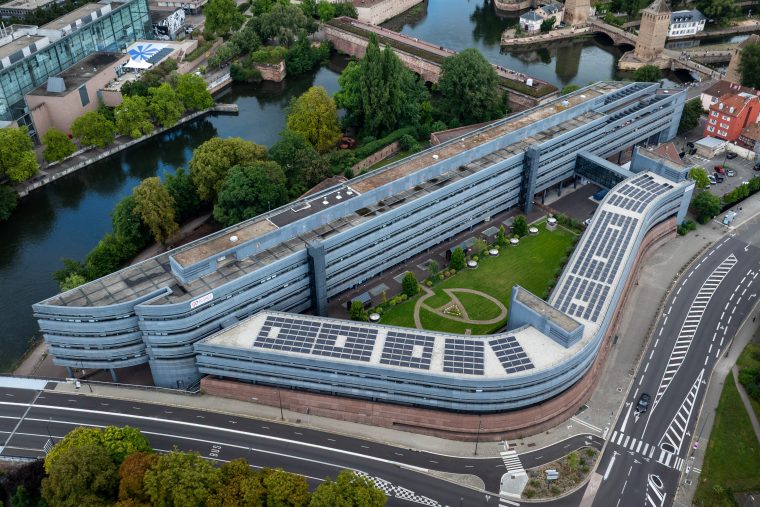 A system comprising 328 photovoltaic panels designed to boost the energy self-sufficiency of the European Community of Alsace (CeA), which achieved savings of ~ €24,000 on its electricity bill in 2025 alone
Click here to download 300dpi images
La Collectivité européenne d’Alsace équipe son siège l’Hôtel d’Alsace au cœur du centre-ville de Strasbourg d’une centrale solaire pour renforcer son autonomie énergétique
· Installée sur les toits de l’Hôtel d’Alsace, cette nouvelle centrale photovoltaïque marque une étape majeure dans la stratégie à long terme de la CeA en matière d’énergie propre et de maîtrise des coûts.
· La centrale solaire atteint un taux d’autoconsommation de 100 %, couvrant un peu moins de 10 % des besoins énergétiques du site, soit une économie de ~24 000 € sur sa facture d’électricité en 2025.
· A l’instar de la plupart des sites déjà équipés en photovoltaïque par la collectivité, la technologie solaire innovante de SolarEdge avec Optimiseurs de Puissance a été choisi pour pallier les limites des systèmes solaires de chaînes traditionnels, dans le but d’optimiser le rendement et d’améliorer la sécurité.
Strasbourg, France – 5 juillet 2026 – La Collectivité européenne d’Alsace (CeA) annonce la mise en service d’une centrale solaire en autoconsommation sur les toits de l’Hôtel d’Alsace, son siège situé au cœur de Strasbourg. Cette nouvelle installation s’inscrit dans une stratégie engagée de longue date en faveur de la transition énergétique et de la maîtrise des coûts de fonctionnement de son parc immobilier.
Dans un contexte marqué par l’évolution de la réglementation S21 et par la forte volatilité des prix de l’électricité, la CeA a souhaité sécuriser durablement ses dépenses énergétiques tout en renforçant son autonomie énergétique. À ce titre, la collectivité publique a fait le choix d’investir massivement dans l’énergie solaire. Depuis 2021, elle a équipé 50 sites (dont 46 collèges) cumulant 5,3 MWc et bénéficie déjà d’un retour d’expérience concluant en matière d’autoconsommation solaire. En effet, les sites équipés autoconsomment tout ou partie de la production photovoltaïque et les surplus servent à alimenter d’autres sites de la collectivité, via un circuit court qualifié d’autoconsommation patrimoniale actuellement en expérimentation avec Energies Strasbourg.
Encouragés par ces résultats positifs, les élus de la CeA ont décidé de poursuivre le déploiement d’installations photovoltaïques et l’équipement de l’Hôtel d’Alsace en panneaux solaires permet de concrétiser cet engagement sur l’un des sites principaux de la collectivité.
Estelle Le Roy, Responsable du service énergies renouvelables au sein de la CeA, souligne : « L’Hôtel d’Alsace est un établissement recevant du public à forte valeur patrimoniale, ce qui implique un niveau d’exigence élevé en matière de sécurité électrique et de maîtrise des risques. Il était essentiel d’assurer une protection tant des occupants que du bâtiment en lui-même. Nous avons d’ailleurs la même stratégie dans les collèges, que nous avons élaborée dès le début du plan photovoltaïque, en lien avec les services d’incendies et secours. C’est pour cette raison que nous avons fait le choix de recourir à la technologie innovante des Optimiseurs de Puissance. Installés sous chaque paire de panneaux, ces dispositifs renforcent la sécurité, en garantissant une très faible tension résiduelle en sortie de panneaux en cas de coupure. De plus, ils nous permettent d’avoir un suivi de performance de chaque panneau, ce qui nous aide à optimiser le fonctionnement de nos centrales. »
Une installation sur-mesure pour un projet particulièrement complexe
Implanté en centre-ville et doté d’une architecture singulière avec une toiture courbe, l’Hôtel d’Alsace présentait un niveau de complexité élevé pour y implanter de façon harmonieuse une installation solaire. Une expertise technique et une qualité de dialogue entre maître d’ouvrage, maître d’œuvre, installateur, Architectes des Bâtiments de France et contrôleur technique ont permis de valider la faisabilité du projet et définir la solution la plus adaptée. La situation et la valeur patrimoniale du bâtiment exigeait une réelle approche esthétique en plus des exigences habituelles applicables à tous les projets photovoltaïques de la collectivité.
La courbure de la toiture génère peu de zones d’ombrage, mais celles-ci sont néanmoins prises en compte pour optimiser la production. Les ombrages peuvent réduire significativement l’efficacité des systèmes solaires conventionnels. En effet, avec des onduleurs de chaînes traditionnels, lorsqu’un seul panneau est ombragé et voit ainsi ses performances diminuer, l’ensemble des panneaux raccordés à la même chaîne s’aligne sur celui affichant la performance la plus faible, entraînant une baisse importante de la production globale.
C’est pourquoi la Collectivité européenne d’Alsace a retenu la solution innovante à optimisation DC de SolarEdge, qui repose sur l’utilisation d’Optimiseurs de Puissance installés sous chaque paire de panneaux photovoltaïques. Cette approche permet d’« individualiser » chaque paire de panneaux, de sorte que les performances des modules exposés adéquatement au soleil ne soient pas impactées par ceux ombragés, maximisant ainsi la production d’énergie et garantissant la viabilité économique du projet.
Sur une année, la centrale solaire couvre un peu moins de 10 % de la consommation globale du site, représentant en 2025 une économie annuelle de 24 000 €.
Sécurité maximale pour un ERP d’exception
En tant qu’établissement recevant du public (ERP), le bâtiment est soumis à des exigences de sécurité particulièrement strictes. À cet égard, le système solaire est équipé de la fonction SafeDC™ de SolarEdge, conçue pour réduire automatiquement la tension du champ photovoltaïque à 1 V par optimiseur (tension sans danger au toucher) lorsque que l’onduleur ou le réseau est mis hors tension. Cette fonctionnalité est essentielle pour assurer ainsi la sécurité des occupants, des opérations de maintenance et des équipes d’intervention. Cette exigence de sécurité est d’ailleurs désormais renforcée par la certification CNPP Certified obtenue par SolarEdge pour sa solution de détection d’arcs électriques sur les installation photovoltaïques[1] : une certification reconnue par le référentiel en matière de protection du risque incendie, APSAD D20.
Un projet phare qui inscrit la CeA dans une transition énergétique durable au service du territoire
Avec ce projet emblématique, la Collectivité européenne d’Alsace confirme son rôle d’acteur public moteur dans la transition énergétique territoriale, conciliant innovation technologique, respect du patrimoine et maîtrise des finances publiques.
Cette collaboration fructueuse avec un partenaire technique tel que l’entreprise alsacienne spécialisée dans le photovoltaïque, Enerios Associés a vocation à se poursuivre, puisqu’elle s’inscrit dans le cadre d’un plan de déploiement pluriannuel sur le patrimoine immobilier de la collectivité. Dans une logique d’amélioration continue, elle commence à étudier le recours à des systèmes de stockage permettant d’augmenter encore l’autonomie énergétique.
Martin Wolf, cofondateur & associé d’Enerios Associés, explique : « Cette approche a offert une flexibilité accrue pour la maîtrise d’ouvrage et nous : l’installateur. Face à la complexité multi-façades du bâtiment, cette installation équipée d’Optimiseurs de Puissance a permis une réduction significative du volume de câblage solaires en comparaison à une installation en chaîne traditionnelle. Clairement cela a pesé sur la budgétisation du projet. La solution SolarEdge que nous avons retenue, a aussi permis une mise en service très rapide grâce notamment à son application SetApp (paramétrage) ultra simplifié. Vraiment, intuitif ! Enfin, grâce à l’application dédiée, la supervision très précise permettant d’analyser les défaillances en amont permet de réduire les coûts opérationnels de maintenance curative. Plus concrètement, un suivi à la paire de module nous offre un gain de temps et d’argent. »
Romain Rocamora, Responsable des Ventes et de la Distribution chez SolarEdge, ajoute : « Des projets comme celui de l’Hôtel d’Alsace démontrent comment des technologies solaires avancées peuvent révéler tout le potentiel de bâtiments parmi les plus complexes et sensibles. En combinant une optimisation au niveau du panneau avec des fonctionnalités de sécurité renforcées telles que SafeDC™, nous permettons à des acteurs publics comme la Collectivité européenne d’Alsace de maximiser leur production d’énergie, de garantir les plus hauts standards de sécurité, de simplifier l’exploitation et la maintenance à long terme, et d’accompagner les collectivités locales dans leur transition vers une plus grande indépendance énergétique »
L’installation de l’Hôtel d’Alsace en chiffres
- 328 panneaux photovoltaïques
- 164 optimiseurs de puissance SolarEdge (Optimiseurs P801-4RMLMRY-NM32)
- 1 onduleur SolarEdge SE 100k
- Une puissance installée de 130 kWc
- Un taux d’autoconsommation à 100%
-
Légende : une centrale solaire de 130 kWc, atteignant un taux d'autoconsommation de 100 %, a été installée sur les toits de l’Hôtel d’Alsace au cœur du centre-ville de Strasbourg
Click here to download 300dpi images -
Légende : une installation de 328 panneaux photovoltaïques vouée à renforcer l’autonomie énergétique de la Collectivité européenne d’Alsace (CeA) qui a réalisé rien qu’en 2025, une économie de 24 000 € sur sa facture d'électricité
Click here to download 300dpi images
PRESS ROOM